
AI-Powered Scams: How Cybercriminals Are Making Attacks More Convincing
by Daniil Slesarenko
When Seeing Is No Longer Believing
For years, one of the easiest ways to spot a scam was poor spelling, strange wording, or an obviously fake message.
Artificial intelligence is changing that.
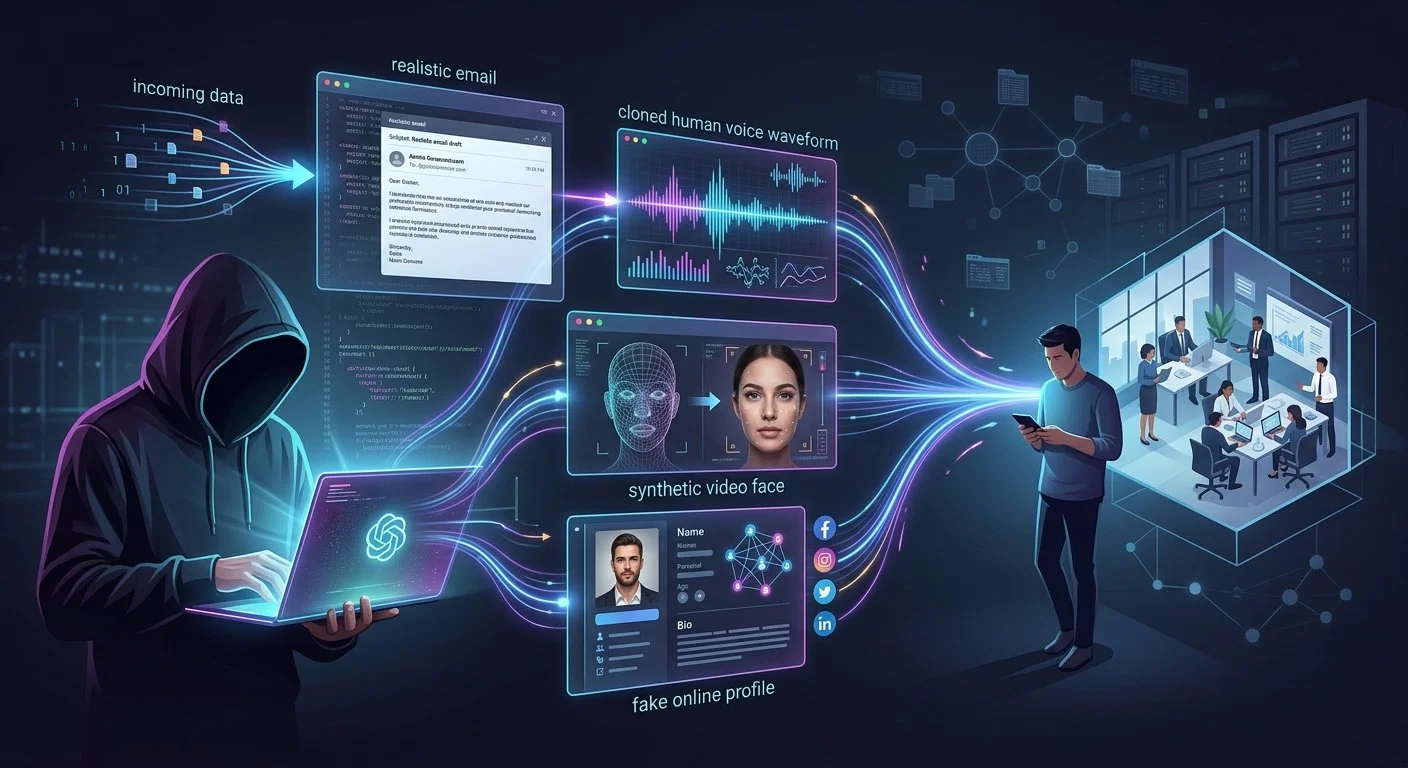
Cybercriminals can now use AI to create convincing emails, messages, images, voices, and videos much faster than before. The result is not necessarily a completely new type of scam. Instead, AI is making familiar scams more believable, more personalized, and harder to recognize.
The technology that helps businesses communicate and create content can also be used by criminals to make their deception look more professional.
How AI Makes Scams More Convincing
AI can remove many of the obvious warning signs that people have traditionally associated with scams.
An attacker can use AI to write a professional-looking email, translate it into another language, generate a convincing profile picture, or create a message that closely matches the way a particular person communicates.
This can make a fake message feel much more legitimate.
Some common examples include:
AI-generated phishing emails with natural language and professional formatting
Fake websites that closely resemble legitimate businesses
AI-generated images used to create fake identities
Voice cloning used to imitate a family member, executive, or other trusted person
Deepfake video used to impersonate someone during a conversation or meeting
The technology doesn't have to be perfect. It only needs to be convincing enough to make someone hesitate less before responding.
The Fake Voice From Someone You Know
One of the more concerning developments is voice cloning.
An attacker may obtain audio of someone's voice from social media, videos, interviews, or other publicly available recordings. AI can then be used to create synthetic speech that sounds like that person.
Imagine receiving a phone call that sounds like your child asking for money because they have an emergency.
Or imagine an employee receiving a voice message that appears to come from their manager asking them to urgently purchase gift cards or transfer funds.
The voice may sound familiar, but the person on the other end may not be who they claim to be.
Canadian intelligence officials have already documented cases involving scammers using voice clones of senior representatives of banks and other high-net-worth organizations.
AI Scams Are Becoming a Canadian Concern
This isn't just a theoretical problem.
The Government of Canada's Competition Bureau has warned that artificial intelligence is helping fraudsters improve existing scams, while the federal government now specifically warns Canadians that scammers can use AI to create realistic messages, images, and websites.
Awareness is becoming important enough that Canada's 2026 national AI strategy includes plans to provide Canadians with access to free AI literacy training. The initiative is intended to help people understand AI and identify issues such as misinformation.
That need extends across generations. An Ipsos survey conducted in Canada found that 67% of Boomers surveyed were aware that scammers use AI tools, while confidence in identifying AI-generated voice or video scams was lower than confidence in identifying more traditional forms of fraud.
The lesson is simple: recognizing a scam increasingly requires more than looking for spelling mistakes or obviously fake websites.
How to Protect Yourself and Your Business
The best defense against AI-powered scams is to slow down when a message creates urgency or asks for something unusual.
Don't assume that a familiar voice, professional-looking email, or realistic video proves that someone is legitimate.
For businesses, some simple practices can make a major difference:
Verify unusual financial or sensitive requests through a separate communication channel
Don't rely on voice or video alone to confirm someone's identity
Be cautious when a message creates unusual urgency or secrecy
Use multi-factor authentication and strong account security
Train employees to recognize increasingly convincing impersonation attempts
A request that sounds exactly like your manager's request may still not come from your manager.
Trust, But Verify
AI is making it easier for attackers to create convincing scams at scale. The problem isn't that every AI-generated message is impossible to detect. The problem is that the old warning signs are becoming less reliable.
A perfectly written email can be fake. A familiar voice can be cloned. A convincing video can be generated.
As AI improves, one of the most important cybersecurity habits is becoming increasingly simple:
Don't trust something just because it looks or sounds real. Verify it.