
Inline Language Translation in ITSM for Multilingual Service Management
By: Danny Tung
Canada’s federal and provincial governments operate within a bilingual workforce. Our IT Service Management (ITSM) solution delivers native multilingual support, enabling self-service employees and Subject Matter Experts (SMEs) to create, view, and update support or service tickets in their preferred language. By integrating inline language translation directly within the ITSM platform, users can instantly access real-time translations of ticket content, providing seamless communication accuracy, accessibility compliance, and overall operational efficiency across bilingual environments.
Business Requirements
St. Lawrence Seaway Management Corp. (SLSMC) operates with a fully bilingual workforce and has deployed our ITSM solution to deliver support and services across IT, HR, and other enterprise functional units.
In a typical scenario, a French-speaking self-service employee submits a service request or support ticket. Due to the limited availability of bilingual support staff, the ticket is often assigned to an English-speaking Subject Matter Expert (SME). Without built-in translation capabilities, the SME encounters challenges in quickly understanding the request details, leading to potential delays, miscommunication, and frustration.
To address this challenge, SLSMC is seeking ITSM translation integration that provides inline language translation within the platform. This capability enables SMEs to instantly translate ticket content in real time, directly within the user interface, without switching languages or relying on external translation tools. The seamless, on-the-fly translation layer removes communication barriers, accelerates ticket resolution, and improves service delivery across multilingual ITSM environments.
Solution to Inline Translation Architecture
Inline language translation is integrated into the ITSM solution through a secure REST API connection to a cloud-based translation service. The technical workflow is outlined below.
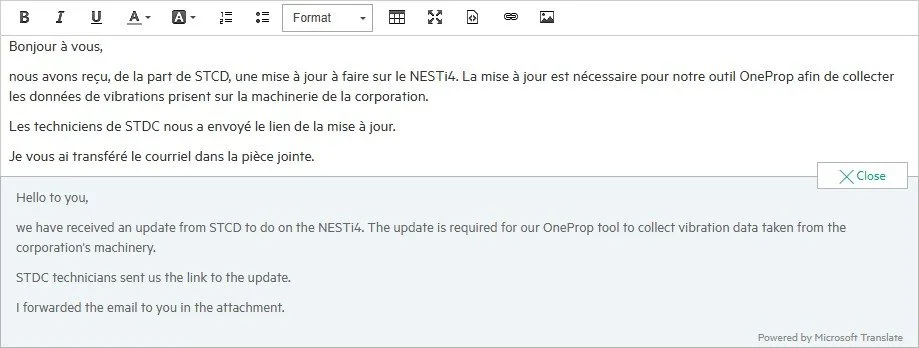
ITSM as the Platform: Provides a user interface (UI) where a context field can be selected and the translation is displayed directly below the original text within the same submitted ticket.
Automatic Language Detection: Our ITSM solution intelligently detects the user’s preferred language when they log into the system.
Translation API as the Engine: This component functions as the core engine, leveraging a cloud-based translation service to deliver real-time ticket translations through standardized REST API calls.
The Middleware: Our ITSM solution includes an integration bridge connecting to the REST API, with no custom coding necessary for basic operations. The middleware performs the following steps:
Waits for users to submit translation requests through the ITSM solution user interface.
Identifies the SME’s language preference selected at login (e.g., French).
Securely transmits the contextual data to the designated cloud Translation API.
Receives the translated context returned by the API.
Displays the translated context within the ITSM solution, positioned directly beneath the original content.
The following screenshot illustrates the result of inline translation performed by the middleware.
Key Benefits
Faster Ticket Resolution Times: SMEs gain instant comprehension of issues reported in any language. With real-time inline translation, there's no delay waiting for human translators, enabling immediate action and significantly reducing average resolution times.
Enhanced User Experience: End-users can submit, view, and interact with support and service tickets in their native language. This personalized, barrier-free experience boosts satisfaction and encourages greater adoption of self-service portals.
Increased Operational Efficiency: Eliminates the cumbersome manual process of copying text to external translation tools and pasting the results back into the ITSM solution. It improves efficiency and service quality, regardless of language barriers.
Seamless Global and Multilingual Collaboration: Enables seamless collaboration across multilingual support personnel and end-users throughout the entire ticket lifecycle, enabling consistent communication across regions and languages.
Improved Service Level Management: Tickets submitted in French, English, or other languages can be handled by any available SME, regardless of their language skills. This flexibility maximizes resource utilization, consistently meets Service Level Objectives (SLOs), improves Key Performance Indicator (KPI) outcomes, and optimizes overall enterprise ITSM service delivery.
Driving Continuous Improvement in Enterprise Service Management
At RealIT Management, we deliver innovative enterprise solutions across IT Service Management (ITSM), IT Asset Management (ITAM), and enterprise observability to help organizations optimize service delivery. Our services include ITIL-aligned process review workshops and comprehensive process gap analyses designed to streamline ticket workflows, improve operational efficiency, and strengthen service governance. Tailored administrator and user training is offered, specifically designed to align with each client’s specific requirements.